
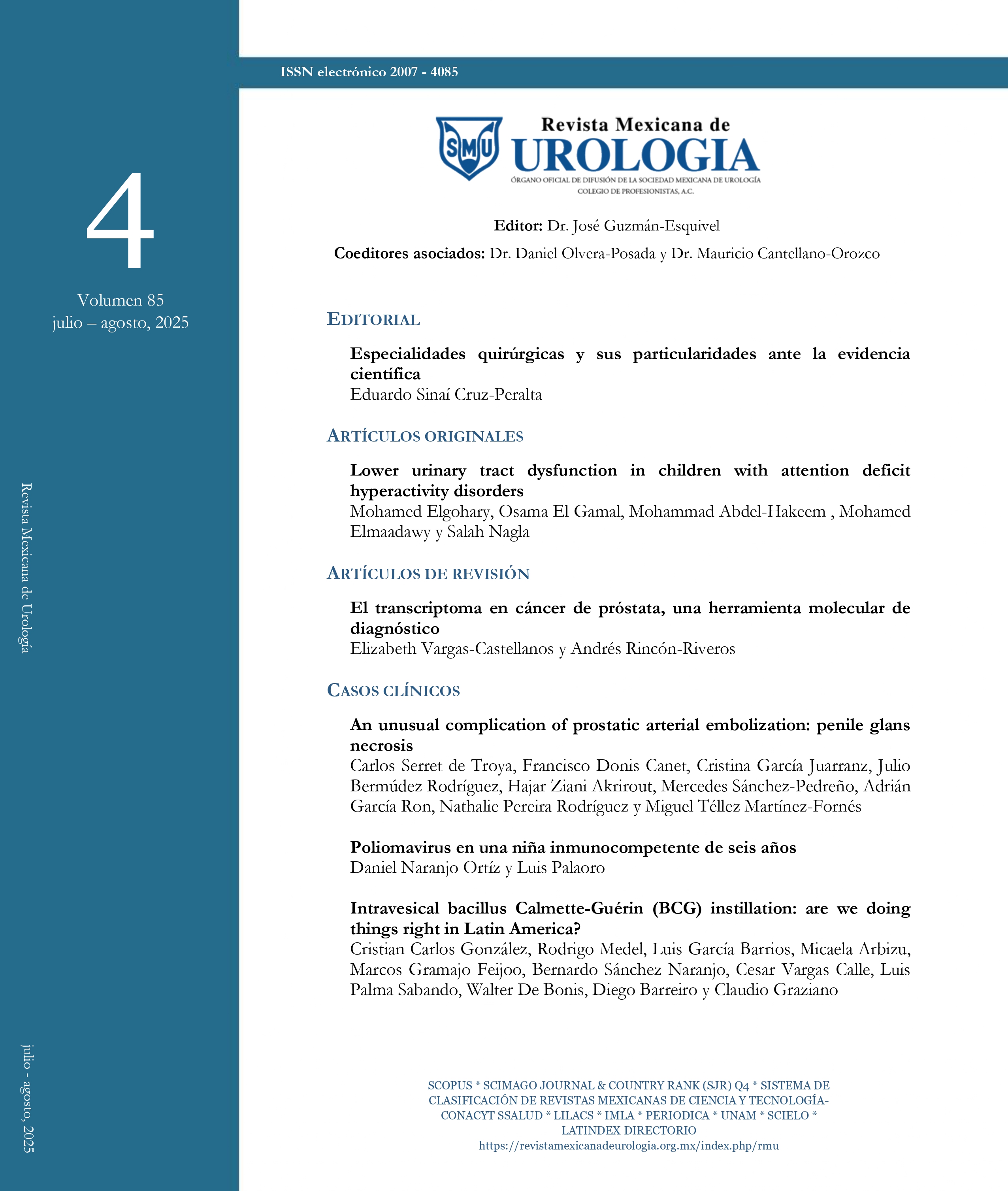
The transcriptome in prostate cancer, a molecular diagnostic tool
DOI:
https://doi.org/10.48193/689c4g40Keywords:
Prostate cancer, Diagnosis, TranscriptomeAbstract
Prostate cancer is a significant cause of cancer-related deaths in men. Early detection is crucial to combat the disease. RNA sequencing is a technique that has revolutionized our understanding of human transcriptome and is now a useful tool for identifying biomarkers that help in diagnosis, prognosis, and monitoring of cancer treatment. This article explores how the transcriptome has become a promising tool for guiding clinical decisions, especially in active surveillance and adjuvant treatments in prostate cancer.
References
Bray F, Laversanne M, Sung H, Ferlay J, Siegel RL, Soerjomataram I, et al. Global cancer statistics 2022: GLOBOCAN estimates of incidence and mortality worldwide for 36 cancers in 185 countries. CA: a cancer journal for clinicians. 2024;74(3): 229–263. https://doi.org/10.3322/caac.21834.
Schafer EJ, Laversanne M, Sung H, Soerjomataram I, Briganti A, Dahut W, et al. Recent Patterns and Trends in Global Prostate Cancer Incidence and Mortality: An Update. European Urology. 2025;87(3): 302–313. https://doi.org/10.1016/j.eururo.2024.11.013.
Pernar CH, Ebot EM, Wilson KM, Mucci LA. The Epidemiology of Prostate Cancer. Cold Spring Harbor Perspectives in Medicine. 2018;8(12): a030361. https://doi.org/10.1101/cshperspect.a030361.
Filella X, Fernández-Galan E, Fernández Bonifacio R, Foj L. Emerging biomarkers in the diagnosis of prostate cancer. Pharmacogenomics and Personalized Medicine. 2018;11: 83–94. https://doi.org/10.2147/PGPM.S136026.
Zelic R, Garmo H, Zugna D, Stattin P, Richiardi L, Akre O, et al. Predicting Prostate Cancer Death with Different Pretreatment Risk Stratification Tools: A Head-to-head Comparison in a Nationwide Cohort Study. European Urology. 2020;77(2): 180–188. https://doi.org/10.1016/j.eururo.2019.09.027.
Cancer Genome Atlas Research Network. The Molecular Taxonomy of Primary Prostate Cancer. Cell. 2015;163(4): 1011–1025. https://doi.org/10.1016/j.cell.2015.10.025.
Swanton C. Intratumor heterogeneity: evolution through space and time. Cancer Research. 2012;72(19): 4875–4882. https://doi.org/10.1158/0008-5472.CAN-12-2217.
Rousseaux S, Debernardi A, Jacquiau B, Vitte AL, Vesin A, Nagy-Mignotte H, et al. Ectopic activation of germline and placental genes identifies aggressive metastasis-prone lung cancers. Science Translational Medicine. 2013;5(186): 186ra66. https://doi.org/10.1126/scitranslmed.3005723.
Barrett CL, DeBoever C, Jepsen K, Saenz CC, Carson DA, Frazer KA. Systematic transcriptome analysis reveals tumor-specific isoforms for ovarian cancer diagnosis and therapy. Proceedings of the National Academy of Sciences of the United States of America. 2015;112(23): E3050–E3057. https://doi.org/10.1073/pnas.1508057112.
Zhao S, Fung-Leung WP, Bittner A, Ngo K, Liu X. Comparison of RNA-Seq and Microarray in Transcriptome Profiling of Activated T Cells. PLOS ONE. 2014;9(1): e78644. https://doi.org/10.1371/journal.pone.0078644.
Howbrook DN, van der Valk AM, O’Shaughnessy MC, Sarker DK, Baker SC, Lloyd AW. Developments in microarray technologies. Drug Discovery Today. 2003;8(14): 642–651. https://doi.org/10.1016/s1359-6446(03)02773-9.
Mantione KJ, Kream RM, Kuzelova H, Ptacek R, Raboch J, Samuel JM, et al. Comparing Bioinformatic Gene Expression Profiling Methods: Microarray and RNA-Seq. Medical Science Monitor Basic Research. 2014;20: 138–141. https://doi.org/10.12659/MSMBR.892101.
Farhangfar CJ, Meric-Bernstam F, Mendelsohn J, Mills GB, Lucio-Eterovic AK. The impact of tumor heterogeneity on patient treatment decisions. Clinical Chemistry. 2013;59(1): 38–40. https://doi.org/10.1373/clinchem.2012.194712.
Samborski A, Miller MC, Blackman A, MacLaughlan-David S, Jackson A, Lambert-Messerlian G, et al. HE4 and CA125 serum biomarker monitoring in women with epithelial ovarian cancer. Tumour Biology: The Journal of the International Society for Oncodevelopmental Biology and Medicine. 2022;44(1): 205–213. https://doi.org/10.3233/TUB-220016.
Thienger P, Rubin MA. Prostate cancer hijacks the microenvironment. Nature Cell Biology. 2021;23(1): 3–5. https://doi.org/10.1038/s41556-020-00616-3.
Salachan PV, Rasmussen M, Ulhøi BP, Jensen JB, Borre M, Sørensen KD. Spatial whole transcriptome profiling of primary tumor from patients with metastatic prostate cancer. International Journal of Cancer. 2023;153(12): 2055–2067. https://doi.org/10.1002/ijc.34708.
Yu X, Liu R, Gao W, Wang X, Zhang Y. Single-cell omics traces the heterogeneity of prostate cancer cells and the tumor microenvironment. Cellular & Molecular Biology Letters. 2023;28(1): 38. https://doi.org/10.1186/s11658-023-00450-z.
Cieślik M, Chinnaiyan AM. Cancer transcriptome profiling at the juncture of clinical translation. Nature Reviews. Genetics. 2018;19(2): 93–109. https://doi.org/10.1038/nrg.2017.96.
Creighton CJ. Gene Expression Profiles in Cancers and Their Therapeutic Implications. Cancer Journal (Sudbury, Mass.). 2023;29(1): 9–14. https://doi.org/10.1097/PPO.0000000000000638.
Haffner MC, Zwart W, Roudier MP, True LD, Nelson WG, Epstein JI, et al. Genomic and phenotypic heterogeneity in prostate cancer. Nature Reviews. Urology. 2021;18(2): 79–92. https://doi.org/10.1038/s41585-020-00400-w.
Kristiansen G. Diagnostic and prognostic molecular biomarkers for prostate cancer. Histopathology. 2012;60(1): 125–141. https://doi.org/10.1111/j.1365-2559.2011.04083.x.
Schaeffer E, Srinivas S, Antonarakis ES, Armstrong AJ, Bekelman JE, Cheng H, et al. NCCN Guidelines Insights: Prostate Cancer, Version 1.2021. Journal of the National Comprehensive Cancer Network: JNCCN. 2021;19(2): 134–143. https://doi.org/10.6004/jnccn.2021.0008.
Modelska A, Quattrone A, Re A. Molecular portraits: the evolution of the concept of transcriptome-based cancer signatures. Briefings in Bioinformatics. 2015;16(6): 1000–1007. https://doi.org/10.1093/bib/bbv013.
Hong M, Tao S, Zhang L, Diao LT, Huang X, Huang S, et al. RNA sequencing: new technologies and applications in cancer research. Journal of Hematology & Oncology. 2020;13(1): 166. https://doi.org/10.1186/s13045-020-01005-x.
Oshlack A, Robinson MD, Young MD. From RNA-seq reads to differential expression results. Genome Biology. 2010;11(12): 220. https://doi.org/10.1186/gb-2010-11-12-220.
Lu Y, Beeghly-Fadiel A, Wu L, Guo X, Li B, Schildkraut JM, et al. A Transcriptome-Wide Association Study Among 97,898 Women to Identify Candidate Susceptibility Genes for Epithelial Ovarian Cancer Risk. Cancer Research. 2018;78(18): 5419–5430. https://doi.org/10.1158/0008-5472.CAN-18-0951.
Parra-Medina R, López-Kleine L, Ramírez-Clavijo S, Payán-Gómez C. Identification of candidate miRNAs in early-onset and late-onset prostate cancer by network analysis. Scientific Reports. 2020;10(1): 12345. https://doi.org/10.1038/s41598-020-69290-7.
Singh B, Trincado JL, Tatlow PJ, Piccolo SR, Eyras E. Genome Sequencing and RNA-Motif Analysis Reveal Novel Damaging Noncoding Mutations in Human Tumors. Molecular cancer research: MCR. 2018;16(7): 1112–1124. https://doi.org/10.1158/1541-7786.MCR-17-0601.
Ma X, Guo J, Liu K, Chen L, Liu D, Dong S, et al. Identification of a distinct luminal subgroup diagnosing and stratifying early stage prostate cancer by tissue-based single-cell RNA sequencing. Molecular Cancer. 2020;19(1): 147. https://doi.org/10.1186/s12943-020-01264-9.
Brady L, Kriner M, Coleman I, Morrissey C, Roudier M, True LD, et al. Inter- and intra-tumor heterogeneity of metastatic prostate cancer determined by digital spatial gene expression profiling. Nature Communications. 2021;12(1): 1426. https://doi.org/10.1038/s41467-021-21615-4.
Akhoundova D, Feng FY, Pritchard CC, Rubin MA. Molecular Genetics of Prostate Cancer and Role of Genomic Testing. Surgical Pathology Clinics. 2022;15(4): 617–628. https://doi.org/10.1016/j.path.2022.08.002.
Rubin MA, Girelli G, Demichelis F. Genomic Correlates to the Newly Proposed Grading Prognostic Groups for Prostate Cancer. European Urology. 2016;69(4): 557–560. https://doi.org/10.1016/j.eururo.2015.10.040.
Lapointe J, Li C, Higgins JP, van de Rijn M, Bair E, Montgomery K, et al. Gene expression profiling identifies clinically relevant subtypes of prostate cancer. Proceedings of the National Academy of Sciences of the United States of America. 2004;101(3): 811–816. https://doi.org/10.1073/pnas.0304146101.
Strømme JM, Johannessen B, Kidd SG, Bogaard M, Carm KT, Zhang X, et al. Expressed prognostic biomarkers for primary prostate cancer independent of multifocality and transcriptome heterogeneity. Cancer Gene Therapy. 2022;29(8–9): 1276–1284. https://doi.org/10.1038/s41417-022-00444-7.
St. John J, Powell K, Conley-LaComb MK, Chinni SR. TMPRSS2-ERG Fusion Gene Expression in Prostate Tumor Cells and Its Clinical and Biological Significance in Prostate Cancer Progression. Journal of cancer science & therapy. 2012;4(4): 94–101. https://doi.org/10.4172/1948-5956.1000119.
Fernández-Serra A, Rubio-Briones J, García-Casado Z, Solsona E, López-Guerrero JA. [Prostate cancer: the revolution of the fusion genes]. Actas Urologicas Espanolas. 2011;35(7): 420–428. https://doi.org/10.1016/j.acuro.2010.11.019.
Cotter K, Rubin MA. The evolving landscape of prostate cancer somatic mutations. The Prostate. 2022;82 Suppl 1(Suppl 1): S13–S24. https://doi.org/10.1002/pros.24353.
Kobelyatskaya AA, Pudova EA, Katunina IV, Snezhkina AV, Fedorova MS, Pavlov VS, et al. Transcriptome Profiling of Prostate Cancer, Considering Risk Groups and the TMPRSS2-ERG Molecular Subtype. International Journal of Molecular Sciences. 2023;24(11): 9282. https://doi.org/10.3390/ijms24119282.
Minner S, Gärtner M, Freudenthaler F, Bauer M, Kluth M, Salomon G, et al. Marked heterogeneity of ERG expression in large primary prostate cancers. Modern Pathology: An Official Journal of the United States and Canadian Academy of Pathology, Inc. 2013;26(1): 106–116. https://doi.org/10.1038/modpathol.2012.130.
Barry M, Perner S, Demichelis F, Rubin MA. TMPRSS2-ERG fusion heterogeneity in multifocal prostate cancer: clinical and biologic implications. Urology. 2007;70(4): 630–633. https://doi.org/10.1016/j.urology.2007.08.032.
Schimmelpfennig C, Rade M, Füssel S, Löffler D, Blumert C, Bertram C, et al. Characterization and evaluation of gene fusions as a measure of genetic instability and disease prognosis in prostate cancer. BMC cancer. 2023;23(1): 575. https://doi.org/10.1186/s12885-023-11019-6.
Kral M, Kurfurstova D, Zemla P, Elias M, Bouchal J. New biomarkers and multiplex tests for diagnosis of aggressive prostate cancer and therapy management. Frontiers in Oncology. 2025;15: 1542511. https://doi.org/10.3389/fonc.2025.1542511.
Roidos C, Anastasiadis A, Tsiakaras S, Loutradis C, Baniotis P, Memmos D, et al. Integration of Genomic Tests in Prostate Cancer Care: Implications for Clinical Practice and Patient Outcomes. Current Issues in Molecular Biology. 2024;46(12): 14408–14421. https://doi.org/10.3390/cimb46120864.
Liu HE, Vuppalapaty M, Hoerner CR, Bergstrom CP, Chiu M, Lemaire C, et al. Detecting androgen receptor (AR), AR variant 7 (AR-V7), prostate-specific membrane antigen (PSMA), and prostate-specific antigen (PSA) gene expression in CTCs and plasma exosome-derived cfRNA in patients with metastatic castration-resistant prostate cancer (mCRPC) by integrating the VTX-1 CTC isolation system with the QIAGEN AdnaTest. BMC cancer. 2024;24(1): 482. https://doi.org/10.1186/s12885-024-12139-3.
Antonarakis ES, Lu C, Wang H, Luber B, Nakazawa M, Roeser JC, et al. AR-V7 and Resistance to Enzalutamide and Abiraterone in Prostate Cancer. New England Journal of Medicine. 2014;371(11): 1028–1038. https://doi.org/10.1056/NEJMoa1315815.
Feng FY, Huang HC, Spratt DE, Zhao SG, Sandler HM, Simko JP, et al. Validation of a 22-Gene Genomic Classifier in Patients With Recurrent Prostate Cancer: An Ancillary Study of the NRG/RTOG 9601 Randomized Clinical Trial. JAMA oncology. 2021;7(4): 544–552. https://doi.org/10.1001/jamaoncol.2020.7671.
Cuzick J, Swanson GP, Fisher G, Brothman AR, Berney DM, Reid JE, et al. Prognostic value of an RNA expression signature derived from cell cycle proliferation genes in patients with prostate cancer: a retrospective study. The Lancet. Oncology. 2011;12(3): 245–255. https://doi.org/10.1016/S1470-2045(10)70295-3.
Tosoian JJ, Zhang Y, Xiao L, Xie C, Samora NL, Niknafs YS, et al. Development and Validation of an 18-Gene Urine Test for High-Grade Prostate Cancer. JAMA oncology. 2024;10(6): 726–736. https://doi.org/10.1001/jamaoncol.2024.0455.
Klein EA, Cooperberg MR, Magi-Galluzzi C, Simko JP, Falzarano SM, Maddala T, et al. A 17-gene assay to predict prostate cancer aggressiveness in the context of Gleason grade heterogeneity, tumor multifocality, and biopsy undersampling. European Urology. 2014;66(3): 550–560. https://doi.org/10.1016/j.eururo.2014.05.004.
Tutrone R, Donovan MJ, Torkler P, Tadigotla V, McLain T, Noerholm M, et al. Clinical utility of the exosome based ExoDx Prostate(IntelliScore) EPI test in men presenting for initial Biopsy with a PSA 2-10 ng/mL. Prostate Cancer and Prostatic Diseases. 2020;23(4): 607–614. https://doi.org/10.1038/s41391-020-0237-z.
Maggi M, Del Giudice F, Falagario UG, Cocci A, Russo GI, Di Mauro M, et al. SelectMDx and Multiparametric Magnetic Resonance Imaging of the Prostate for Men Undergoing Primary Prostate Biopsy: A Prospective Assessment in a Multi-Institutional Study. Cancers. 2021;13(9): 2047. https://doi.org/10.3390/cancers13092047.
Durand X, Moutereau S, Xylinas E, de la Taille A. ProgensaTM PCA3 test for prostate cancer. Expert Review of Molecular Diagnostics. 2011;11(2): 137–144. https://doi.org/10.1586/erm.10.122.
Ma C, Zhou Y, Fanelli GN, Stopsack KH, Fiorentino M, Zadra G, et al. The Prostate Stromal Transcriptome in Aggressive and Lethal Prostate Cancer. Molecular cancer research: MCR. 2023;21(3): 253–260. https://doi.org/10.1158/1541-7786.MCR-22-0627.
Aran D, Camarda R, Odegaard J, Paik H, Oskotsky B, Krings G, et al. Comprehensive analysis of normal adjacent to tumor transcriptomes. Nature Communications. 2017;8(1): 1077. https://doi.org/10.1038/s41467-017-01027-z.
Hernandez G. Cáncer de próstata: Conceptos biomoleculares Prostate cancer: Biomolecular concepts. Carcinos. 2014;4(2). h
Feng D, Xiong Q, Wei Q, Yang L. Cellular landscape of tumour microenvironment in prostate cancer. Immunology. 2023;168(2): 199–202. https://doi.org/10.1111/imm.13456.
Bu L, Baba H, Yoshida N, Miyake K, Yasuda T, Uchihara T, et al. Biological heterogeneity and versatility of cancer-associated fibroblasts in the tumor microenvironment. Oncogene. 2019;38(25): 4887–4901. https://doi.org/10.1038/s41388-019-0765-y.
Mhaidly R, Mechta-Grigoriou F. Fibroblast heterogeneity in tumor micro-environment: Role in immunosuppression and new therapies. Seminars in Immunology. 2020;48: 101417. https://doi.org/10.1016/j.smim.2020.101417.
Loeb S, Vellekoop A, Ahmed HU, Catto J, Emberton M, Nam R, et al. Systematic review of complications of prostate biopsy. European Urology. 2013;64(6): 876–892. https://doi.org/10.1016/j.eururo.2013.05.049.
Cooper CS, Eeles R, Wedge DC, Van Loo P, Gundem G, Alexandrov LB, et al. Analysis of the genetic phylogeny of multifocal prostate cancer identifies multiple independent clonal expansions in neoplastic and morphologically normal prostate tissue. Nature Genetics. 2015;47(4): 367–372. https://doi.org/10.1038/ng.3221.
Jeon J, Olkhov-Mitsel E, Xie H, Yao CQ, Zhao F, Jahangiri S, et al. Temporal Stability and Prognostic Biomarker Potential of the Prostate Cancer Urine miRNA Transcriptome. Journal of the National Cancer Institute. 2020;112(3): 247–255. https://doi.org/10.1093/jnci/djz112.
Cortese R, Kwan A, Lalonde E, Bryzgunova O, Bondar A, Wu Y, et al. Epigenetic markers of prostate cancer in plasma circulating DNA. Human Molecular Genetics. 2012;21(16): 3619–3631. https://doi.org/10.1093/hmg/dds192.
Salido-Guadarrama AI, Morales-Montor JG, Rangel-Escareño C, Langley E, Peralta-Zaragoza O, Cruz Colin JL, et al. Urinary microRNA-based signature improves accuracy of detection of clinically relevant prostate cancer within the prostate-specific antigen grey zone. Molecular Medicine Reports. 2016;13(6): 4549–4560. https://doi.org/10.3892/mmr.2016.5095.
Peng Y, Croce CM. The role of MicroRNAs in human cancer. Signal Transduction and Targeted Therapy. 2016;1: 15004. https://doi.org/10.1038/sigtrans.2015.4.
Stavast CJ, Erkeland SJ. The Non-Canonical Aspects of MicroRNAs: Many Roads to Gene Regulation. Cells. 2019;8(11): 1465. https://doi.org/10.3390/cells8111465.
Rana S, Valbuena GN, Curry E, Bevan CL, Keun HC. MicroRNAs as biomarkers for prostate cancer prognosis: a systematic review and a systematic reanalysis of public data. British Journal of Cancer. 2022;126(3): 502–513. https://doi.org/10.1038/s41416-021-01677-3.
Chen S, Lu C, Lin S, Sun C, Wen Z, Ge Z, et al. A panel based on three-miRNAs as diagnostic biomarker for prostate cancer. Frontiers in Genetics. 2024;15. https://doi.org/10.3389/fgene.2024.1371441.
Statello L, Guo CJ, Chen LL, Huarte M. Gene regulation by long non-coding RNAs and its biological functions. Nature Reviews. Molecular Cell Biology. 2021;22(2): 96–118. https://doi.org/10.1038/s41580-020-00315-9.
Bridges MC, Daulagala AC, Kourtidis A. LNCcation: lncRNA localization and function. The Journal of Cell Biology. 2021;220(2): e202009045. https://doi.org/10.1083/jcb.202009045.
Ferreira LB, Palumbo A, de Mello KD, Sternberg C, Caetano MS, de Oliveira FL, et al. PCA3 noncoding RNA is involved in the control of prostate-cancer cell survival and modulates androgen receptor signaling. BMC cancer. 2012;12: 507. https://doi.org/10.1186/1471-2407-12-507.
Lemos AEG, Matos A da R, Ferreira LB, Gimba ERP. The long non-coding RNA PCA3: an update of its functions and clinical applications as a biomarker in prostate cancer. Oncotarget. 2019;10(61): 6589–6603. https://doi.org/10.18632/oncotarget.27284.
Zhao S, Prensner JR, Erho N, Ghadessi M, Yousefi K, Wellman H, et al. Identification and Validation of the Long Noncoding RNA SChLAP1 as a Prognostic Biomarker in Prostate Cancer. International Journal of Radiation Oncology, Biology, Physics. 2014;90(1): S2. https://doi.org/10.1016/j.ijrobp.2014.06.020.
Prensner JR, Iyer MK, Sahu A, Asangani IA, Cao Q, Patel L, et al. The long noncoding RNA SChLAP1 promotes aggressive prostate cancer and antagonizes the SWI/SNF complex. Nature Genetics. 2013;45(11): 1392–1398. https://doi.org/10.1038/ng.2771.
Parra-Medina R, López-Kleine L, Ramírez-Clavijo S, Payán-Gómez C. Coexpression network analysis identified lncRNAs-mRNAs with potential relevance in African ancestry prostate cancer. Future science OA. 2021;7(9): FSO749. https://doi.org/10.2144/fsoa-2021-0076.
Downloads
Published
Issue
Section
License
Copyright (c) 2025 Revista Mexicana de Urología

This work is licensed under a Creative Commons Attribution-NonCommercial-NoDerivatives 4.0 International License.


