
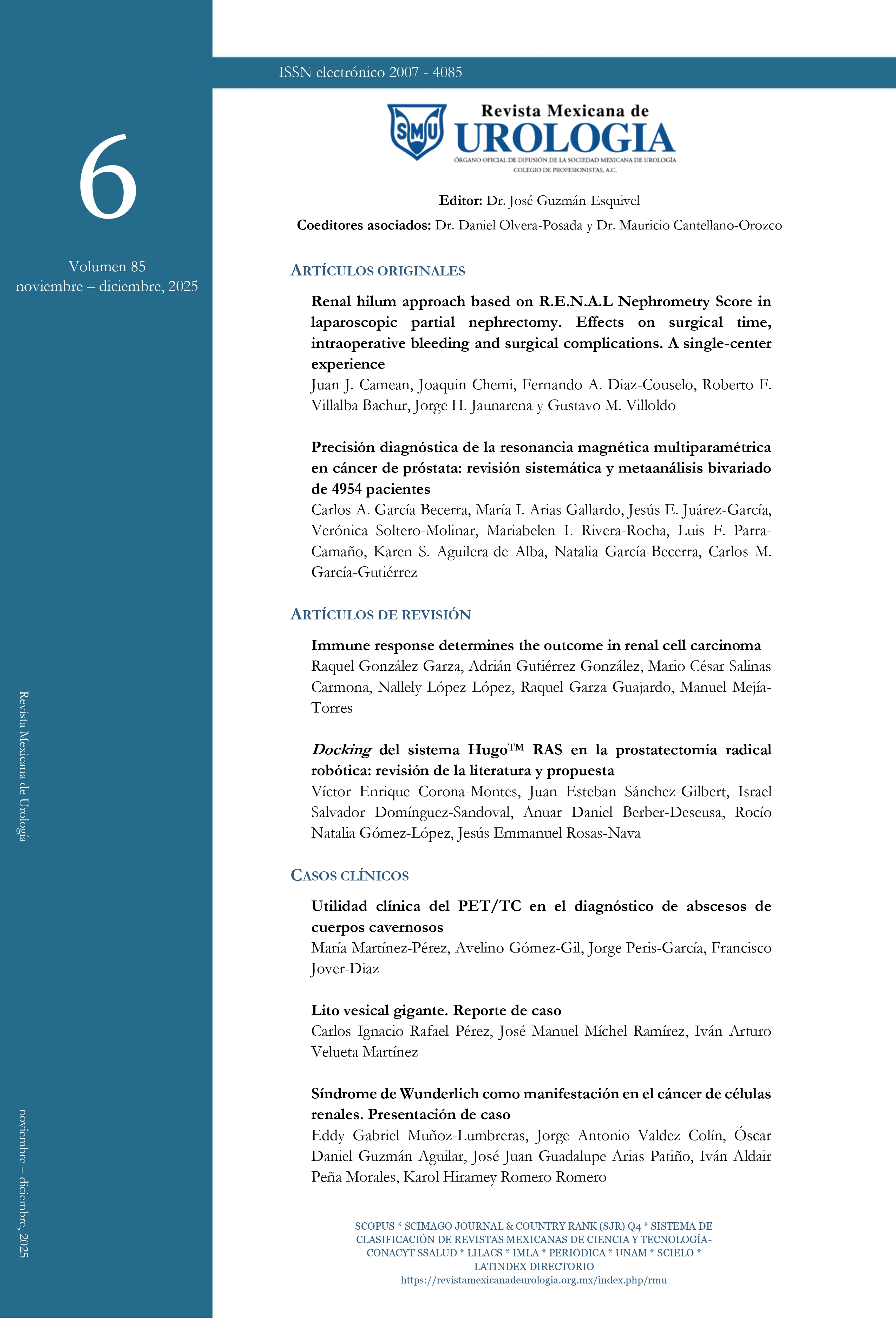
Diagnostic accuracy of multiparametric magnetic resonance imaging in prostate cancer: systematic review and bivariate meta-analysis of 4954 patients
DOI:
https://doi.org/10.48193/s7g2sh54Keywords:
Magnetic Resonance, Prostatic Neoplasm, Multiparametric MRI, Prostate Cancer, Meta-analysis, DiagnosisAbstract
Introduction: multiparametric magnetic resonance imaging (mpMRI) has proven to be crucial for detecting clinically significant prostate cancer (csPCa), a disease that remains one of the leading causes of morbidity and mortality in men. Studies such as PROMIS and PRECISION show that, when combined with targeted biopsy, mpMRI outperforms systematic transrectal biopsy with 10 to 12 cores in diagnostic accuracy.
Objective: to evaluate the diagnostic efficacy of mpMRI in an updated context.
Design and methods: this study is a subanalysis of a protocol registered in PROSPERO (CRD42024552125). A systematic review was conducted using PubMed, CENTRAL Cochrane, and ClinicalTrials.gov, including articles published between 2012 and 2024. Studies comparing mpMRI with biparametric MRI (bpMRI) were selected. Risk of bias was assessed using the QUADAS-2 tool. Sensitivity, specificity, and area under the curve (AUC) were analyzed through a bivariate model; other diagnostic efficiency indicators were obtained using a univariate model.
Results: nineteen studies with a total of 4954 patients were included. The pooled sensitivity was 90.7 %, specificity 64.4 %, and AUC 0.898, confirming its high diagnostic accuracy.
Limitations: the main limitation was being a subanalysis subject to the guidelines of the original protocol.
Originality and value: this is an updated meta-analysis with robust methodology and a large sample size that reinforces current evidence.
Conclusions: the results demonstrate that mpMRI, even in an updated context and with a large sample size, maintains its high sensitivity, confirming it as an essential tool for the early diagnosis of csPCa.
References
Rawla P. Epidemiology of Prostate Cancer. World Journal of Oncology. 2019;10(2): 63–89. https://doi.org/10.14740/wjon1191.
Gandaglia G, Leni R, Bray F, Fleshner N, Freedland SJ, Kibel A, et al. Epidemiology and Prevention of Prostate Cancer. European Urology Oncology. 2021;4(6): 877–892. https://doi.org/10.1016/j.euo.2021.09.006.
Gnanapragasam VJ, Greenberg D, Burnet N. Urinary symptoms and prostate cancer-the misconception that may be preventing earlier presentation and better survival outcomes. BMC medicine. 2022;20(1): 264. https://doi.org/10.1186/s12916-022-02453-7.
Matoso A, Epstein JI. Defining clinically significant prostate cancer on the basis of pathological findings. Histopathology. 2019;74(1): 135–145. https://doi.org/10.1111/his.13712.
Sopyllo K, Erickson AM, Mirtti T. Grading Evolution and Contemporary Prognostic Biomarkers of Clinically Significant Prostate Cancer. Cancers. 2021;13(4): 628. https://doi.org/10.3390/cancers13040628.
van Leenders GJLH, van der Kwast TH, Grignon DJ, Evans AJ, Kristiansen G, Kweldam CF, et al. The 2019 International Society of Urological Pathology (ISUP) Consensus Conference on Grading of Prostatic Carcinoma. The American Journal of Surgical Pathology. 2020;44(8): e87–e99. https://doi.org/10.1097/PAS.0000000000001497.
Mottet N, van den Bergh RCN, Briers E, Van den Broeck T, Cumberbatch MG, De Santis M, et al. EAU-EANM-ESTRO-ESUR-SIOG Guidelines on Prostate Cancer-2020 Update. Part 1: Screening, Diagnosis, and Local Treatment with Curative Intent. European Urology. 2021;79(2): 243–262. https://doi.org/10.1016/j.eururo.2020.09.042.
Weinreb JC, Barentsz JO, Choyke PL, Cornud F, Haider MA, Macura KJ, et al. PI-RADS Prostate Imaging - Reporting and Data System: 2015, Version 2. European Urology. 2016;69(1): 16–40. https://doi.org/10.1016/j.eururo.2015.08.052.
Barentsz JO, Richenberg J, Clements R, Choyke P, Verma S, Villeirs G, et al. ESUR prostate MR guidelines 2012. European Radiology. 2012;22(4): 746–757. https://doi.org/10.1007/s00330-011-2377-y.
Ahmed HU, El-Shater Bosaily A, Brown LC, Gabe R, Kaplan R, Parmar MK, et al. Diagnostic accuracy of multi-parametric MRI and TRUS biopsy in prostate cancer (PROMIS): a paired validating confirmatory study. Lancet (London, England). 2017;389(10071): 815–822. https://doi.org/10.1016/S0140-6736(16)32401-1.
Kasivisvanathan V, Rannikko AS, Borghi M, Panebianco V, Mynderse LA, Vaarala MH, et al. MRI-Targeted or Standard Biopsy for Prostate-Cancer Diagnosis. The New England Journal of Medicine. 2018;378(19): 1767–1777. https://doi.org/10.1056/NEJMoa1801993.
Page MJ, Moher D, Bossuyt PM, Boutron I, Hoffmann TC, Mulrow CD, et al. PRISMA 2020 explanation and elaboration: updated guidance and exemplars for reporting systematic reviews. 2021; https://doi.org/10.1136/bmj.n160.
Whiting PF, Rutjes AWS, Westwood ME, Mallett S, Deeks JJ, Reitsma JB, et al. QUADAS-2: a revised tool for the quality assessment of diagnostic accuracy studies. Annals of Internal Medicine. 2011;155(8): 529–536. https://doi.org/10.7326/0003-4819-155-8-201110180-00009.
Reitsma JB, Glas AS, Rutjes AWS, Scholten RJPM, Bossuyt PM, Zwinderman AH. Bivariate analysis of sensitivity and specificity produces informative summary measures in diagnostic reviews. Journal of Clinical Epidemiology. 2005;58(10): 982–990. https://doi.org/10.1016/j.jclinepi.2005.02.022.
Zhang J, Xu L, Zhang G, Zhang X, Bai X, Ji Z, et al. Comparison between biparametric and multiparametric MRI diagnosis strategy for prostate cancer in the peripheral zone using PI-RADS version 2.1. Abdominal Radiology (New York). 2022;47(8): 2905–2916. https://doi.org/10.1007/s00261-022-03553-x.
Zawaideh JP, Sala E, Shaida N, Koo B, Warren AY, Carmisciano L, et al. Diagnostic accuracy of biparametric versus multiparametric prostate MRI: assessment of contrast benefit in clinical practice. European Radiology. 2020;30(7): 4039–4049. https://doi.org/10.1007/s00330-020-06782-0.
Xu L, Zhang G, Shi B, Liu Y, Zou T, Yan W, et al. Comparison of biparametric and multiparametric MRI in the diagnosis of prostate cancer. Cancer Imaging: The Official Publication of the International Cancer Imaging Society. 2019;19(1): 90. https://doi.org/10.1186/s40644-019-0274-9.
De Visschere P, Lumen N, Ost P, Decaestecker K, Pattyn E, Villeirs G. Dynamic contrast-enhanced imaging has limited added value over T2-weighted imaging and diffusion-weighted imaging when using PI-RADSv2 for diagnosis of clinically significant prostate cancer in patients with elevated PSA. Clinical Radiology. 2017;72(1): 23–32. https://doi.org/10.1016/j.crad.2016.09.011.
Thestrup KCD, Logager V, Baslev I, Møller JM, Hansen RH, Thomsen HS. Biparametric versus multiparametric MRI in the diagnosis of prostate cancer. Acta Radiologica Open. 2016;5(8): 2058460116663046. https://doi.org/10.1177/2058460116663046.
Thaiss WM, Moser S, Hepp T, Kruck S, Rausch S, Scharpf M, et al. Head-to-head comparison of biparametric versus multiparametric MRI of the prostate before robot-assisted transperineal fusion prostate biopsy. World Journal of Urology. 2022;40(10): 2431–2438. https://doi.org/10.1007/s00345-022-04120-1.
Tamada T, Kido A, Yamamoto A, Takeuchi M, Miyaji Y, Moriya T, et al. Comparison of Biparametric and Multiparametric MRI for Clinically Significant Prostate Cancer Detection With PI-RADS Version 2.1. Journal of magnetic resonance imaging: JMRI. 2021;53(1): 283–291. https://doi.org/10.1002/jmri.27283.
Russo F, Mazzetti S, Regge D, Ambrosini I, Giannini V, Manfredi M, et al. Diagnostic Accuracy of Single-plane Biparametric and Multiparametric Magnetic Resonance Imaging in Prostate Cancer: A Randomized Noninferiority Trial in Biopsy-naïve Men. European Urology Oncology. 2021;4(6): 855–862. https://doi.org/10.1016/j.euo.2021.03.007.
Radtke JP, Boxler S, Kuru TH, Wolf MB, Alt CD, Popeneciu IV, et al. Improved detection of anterior fibromuscular stroma and transition zone prostate cancer using biparametric and multiparametric MRI with MRI-targeted biopsy and MRI-US fusion guidance. Prostate Cancer and Prostatic Diseases. 2015;18(3): 288–296. https://doi.org/10.1038/pcan.2015.29.
Pesapane F, Acquasanta M, Meo RD, Agazzi GM, Tantrige P, Codari M, et al. Comparison of Sensitivity and Specificity of Biparametric versus Multiparametric Prostate MRI in the Detection of Prostate Cancer in 431 Men with Elevated Prostate-Specific Antigen Levels. Diagnostics (Basel, Switzerland). 2021;11(7): 1223. https://doi.org/10.3390/diagnostics11071223.
Van Nieuwenhove S, Saussez TP, Thiry S, Trefois P, Annet L, Michoux N, et al. Prospective comparison of a fast 1.5-T biparametric with the 3.0-T multiparametric ESUR magnetic resonance imaging protocol as a triage test for men at risk of prostate cancer. BJU international. 2019;123(3): 411–420. https://doi.org/10.1111/bju.14538.
Mahajan M, Gupta V, Gupta P, Sharma P, Abrol D. Evaluation of clinically significant prostate cancer using biparametric magnetic resonance imaging: An evolving concept. Journal of Cancer Research and Therapeutics. 2022;18(6): 1640–1645. https://doi.org/10.4103/jcrt.JCRT_1313_20.
Kuhl CK, Bruhn R, Krämer N, Nebelung S, Heidenreich A, Schrading S. Abbreviated Biparametric Prostate MR Imaging in Men with Elevated Prostate-specific Antigen. Radiology. 2017;285(2): 493–505. https://doi.org/10.1148/radiol.2017170129.
Gatti M, Faletti R, Calleris G, Giglio J, Berzovini C, Gentile F, et al. Prostate cancer detection with biparametric magnetic resonance imaging (bpMRI) by readers with different experience: performance and comparison with multiparametric (mpMRI). Abdominal Radiology (New York). 2019;44(5): 1883–1893. https://doi.org/10.1007/s00261-019-01934-3.
van der Leest M, Israël B, Cornel EB, Zámecnik P, Schoots IG, van der Lelij H, et al. High Diagnostic Performance of Short Magnetic Resonance Imaging Protocols for Prostate Cancer Detection in Biopsy-naïve Men: The Next Step in Magnetic Resonance Imaging Accessibility. European Urology. 2019;76(5): 574–581. https://doi.org/10.1016/j.eururo.2019.05.029.
Choi MH, Kim CK, Lee YJ, Jung SE. Prebiopsy Biparametric MRI for Clinically Significant Prostate Cancer Detection With PI-RADS Version 2: A Multicenter Study. AJR. American journal of roentgenology. 2019;212(4): 839–846. https://doi.org/10.2214/AJR.18.20498.
Brembilla G, Giganti F, Sidhu H, Imbriaco M, Mallett S, Stabile A, et al. Diagnostic Accuracy of Abbreviated Bi-Parametric MRI (a-bpMRI) for Prostate Cancer Detection and Screening: A Multi-Reader Study. Diagnostics (Basel, Switzerland). 2022;12(2): 231. https://doi.org/10.3390/diagnostics12020231.
Barth BK, De Visschere PJL, Cornelius A, Nicolau C, Vargas HA, Eberli D, et al. Detection of Clinically Significant Prostate Cancer: Short Dual-Pulse Sequence versus Standard Multiparametric MR Imaging-A Multireader Study. Radiology. 2017;284(3): 725–736. https://doi.org/10.1148/radiol.2017162020.
Bao J, Zhi R, Hou Y, Zhang J, Wu CJ, Wang XM, et al. Optimized MRI Assessment for Clinically Significant Prostate Cancer: A STARD-Compliant Two-Center Study. Journal of magnetic resonance imaging: JMRI. 2021;53(4): 1210–1219. https://doi.org/10.1002/jmri.27394.
Bass EJ, Pantovic A, Connor MJ, Loeb S, Rastinehad AR, Winkler M, et al. Diagnostic accuracy of magnetic resonance imaging targeted biopsy techniques compared to transrectal ultrasound guided biopsy of the prostate: a systematic review and meta-analysis. Prostate Cancer and Prostatic Diseases. 2022;25(2): 174–179. https://doi.org/10.1038/s41391-021-00449-7.
Heard JR, Naser-Tavakolian A, Nazmifar M, Ahdoot M. Focal prostate cancer therapy in the era of multiparametric MRI: a review of options and outcomes. Prostate Cancer and Prostatic Diseases. 2023;26(2): 218–227. https://doi.org/10.1038/s41391-022-00501-0.
Downloads
Published
Issue
Section
License
Copyright (c) 2026 Revista Mexicana de Urología

This work is licensed under a Creative Commons Attribution-NonCommercial-NoDerivatives 4.0 International License.


