
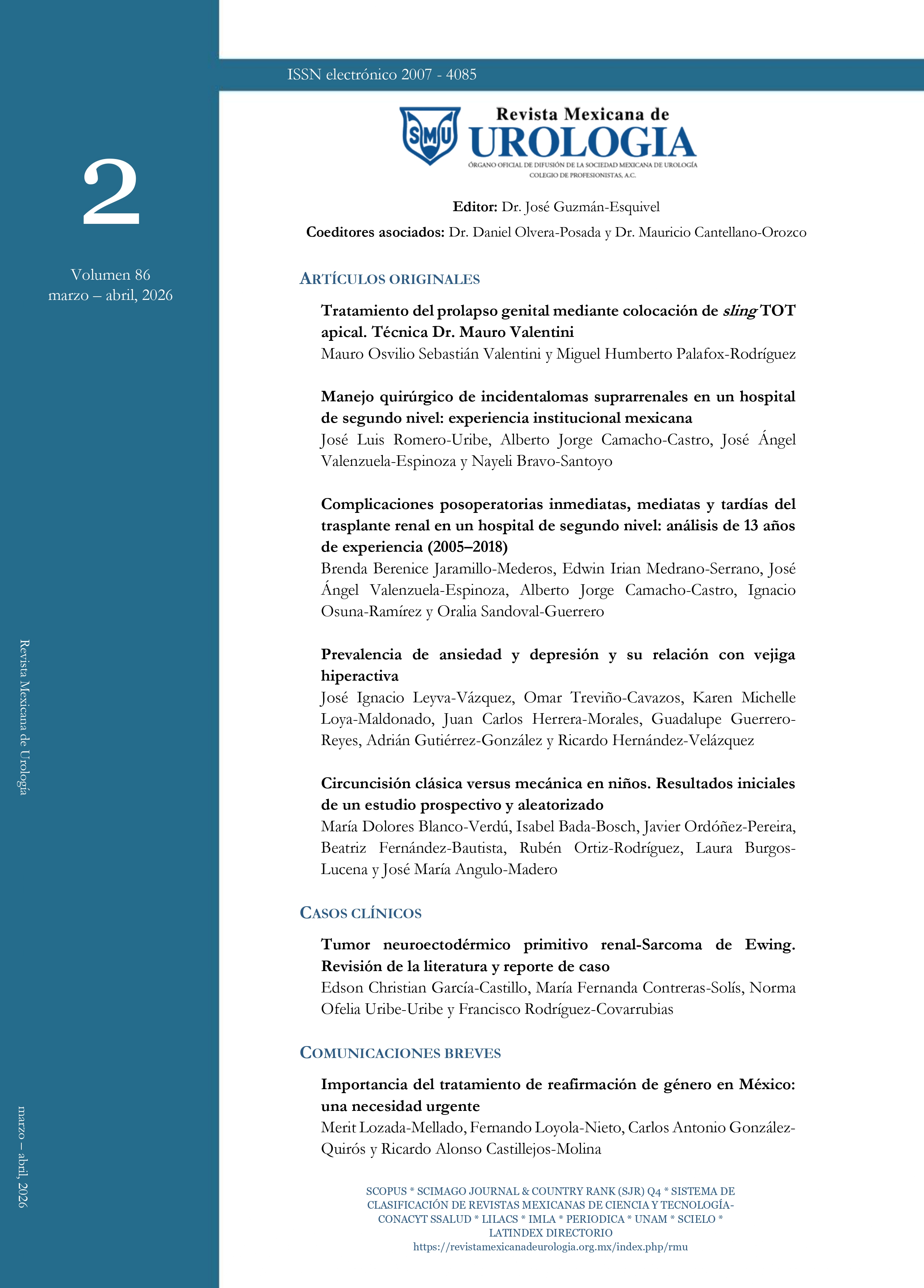
Treatment of genital prolapse by placing a TOT apical sling. Technique of Dr. Mauro Valentini
DOI:
https://doi.org/10.48193/2xaqfr31Keywords:
Pelvic Organ Prolapse, Surgical Mesh, Vaginal Surgery, Apical Prolapse, Vaginal Sling, Anterior Compartment, Cystocele repair, TOTAbstract
Introduction: retrospective and descriptive study of a new alternative technique in patients with genital prolapse; combining anterior prolapse repair technique with the placement of a trans-obturator sling in the apical component.
Objective: demonstrate the steps to perform the new technique in patients with genital prolapse and share the results.
Method: during the period between December 2020 and December 2024, a total of 150 women with genital prolapse were selected, who were treated with anterior prolapse repair techniques plus placement of a TOT sling through the lower part of the obturator orifice anchored to the apical component, the average age was 63 years, all had previous urological and gynecological studies. The patients had varying degrees of prolapse, with GIII being the most common. The hospital stay was 24 hours. Upon discharge, they were allowed to perform light tasks after 15 days, and heavy tasks and sexual intercourse after 45 days.
Results: after an average follow-up of 24 months, no complications related to the technique or the sling were observed, and the patients presented a high level of compliance and satisfaction. The overall rate of patients reported that they did not regret the procedure.
Conclusions: in our experience during this period, we see that this technique is reproducible with a rapid learning curve and provides adequate support for patients, resulting in highly satisfactory results for their quality of life.
References
Hendrix SL, Clark A, Nygaard I, Aragaki A, Barnabei V, McTiernan A. Pelvic organ prolapse in the Women’s Health Initiative: gravity and gravidity. American Journal of Obstetrics and Gynecology. 2002;186(6): 1160–1166. https://doi.org/10.1067/mob.2002.123819.
Resel Folkersma L, Vozmediano Chicharro R, González López R, Jiménez Calvo J, Escribano Patiño G, Conde Santos G, et al. Consenso de la Asociación Española de Urología sobre el uso de mallas en la cirugía del prolapso de órganos pélvicos. Actas Urológicas Españolas. 2020;44(8): 529–534. https://doi.org/10.1016/j.acuro.2020.04.007.
Olsen AL, Smith VJ, Bergstrom JO, Colling JC, Clark AL. Epidemiology of surgically managed pelvic organ prolapse and urinary incontinence. Obstetrics and Gynecology. 1997;89(4): 501–506. https://doi.org/10.1016/S0029-7844(97)00058-6.
Scientific Committee on Emerging and Newly Identified Health Risks. Opinion on The safety of surgical meshes used in urogynecological surgery. 2015.
Hugele F, Panel L, Farache C, Kashef A, Cornille A, Courtieu C. Two years follow up of 270 patients treated by transvaginal mesh for anterior and/or apical prolapse. European Journal of Obstetrics, Gynecology, and Reproductive Biology. 2017;208: 16–22. https://doi.org/10.1016/j.ejogrb.2016.10.015.
Alas AN, Pereira I, Chandrasekaran N, Devakumar H, Espaillat L, Hurtado E, et al. Apical sling: an approach to posthysterectomy vault prolapse. International Urogynecology Journal. 2016;27(9): 1433–1436. https://doi.org/10.1007/s00192-016-3010-z.
Altman D, Mikkola TS, Bek KM, Rahkola-Soisalo P, Gunnarsson J, Engh ME, et al. Pelvic organ prolapse repair using the UpholdTM Vaginal Support System: a 1-year multicenter study. International Urogynecology Journal. 2016;27(9): 1337–1345. https://doi.org/10.1007/s00192-016-2973-0.
Maher C, Feiner B, Baessler K, Christmann-Schmid C, Haya N, Brown J. Surgery for women with apical vaginal prolapse. The Cochrane Database of Systematic Reviews. 2016;10(10): CD012376. https://doi.org/10.1002/14651858.CD012376.
Maher C, Feiner B, Baessler K, Christmann-Schmid C, Haya N, Marjoribanks J. Transvaginal mesh or grafts compared with native tissue repair for vaginal prolapse. The Cochrane Database of Systematic Reviews. 2016;2(2): CD012079. https://doi.org/10.1002/14651858.CD012079.
Torras Caral I, Ros Cerro C, Espuña Pons M. Tratamiento quirúrgico del prolapso apical. Suelo Pélvico. 2022;15(2). https://revistasuelopelvico.com/wp-content/uploads/2022/09/105570-SUELO-PELVICO-152-revision.pdf
Larouche M, Belzile E, Geoffrion R. Surgical Management of Symptomatic Apical Pelvic Organ Prolapse: A Systematic Review and Meta-analysis. Obstetrics and Gynecology. 2021;137(6): 1061–1073. https://doi.org/10.1097/AOG.0000000000004393.
Meriwether KV, Antosh DD, Olivera CK, Kim-Fine S, Balk EM, Murphy M, et al. Uterine preservation vs hysterectomy in pelvic organ prolapse surgery: a systematic review with meta-analysis and clinical practice guidelines. American Journal of Obstetrics and Gynecology. 2018;219(2): 129-146.e2. https://doi.org/10.1016/j.ajog.2018.01.018.
Downloads
Published
Issue
Section
License
Copyright (c) 2026 Revista Mexicana de Urología

This work is licensed under a Creative Commons Attribution-NonCommercial-NoDerivatives 4.0 International License.


