
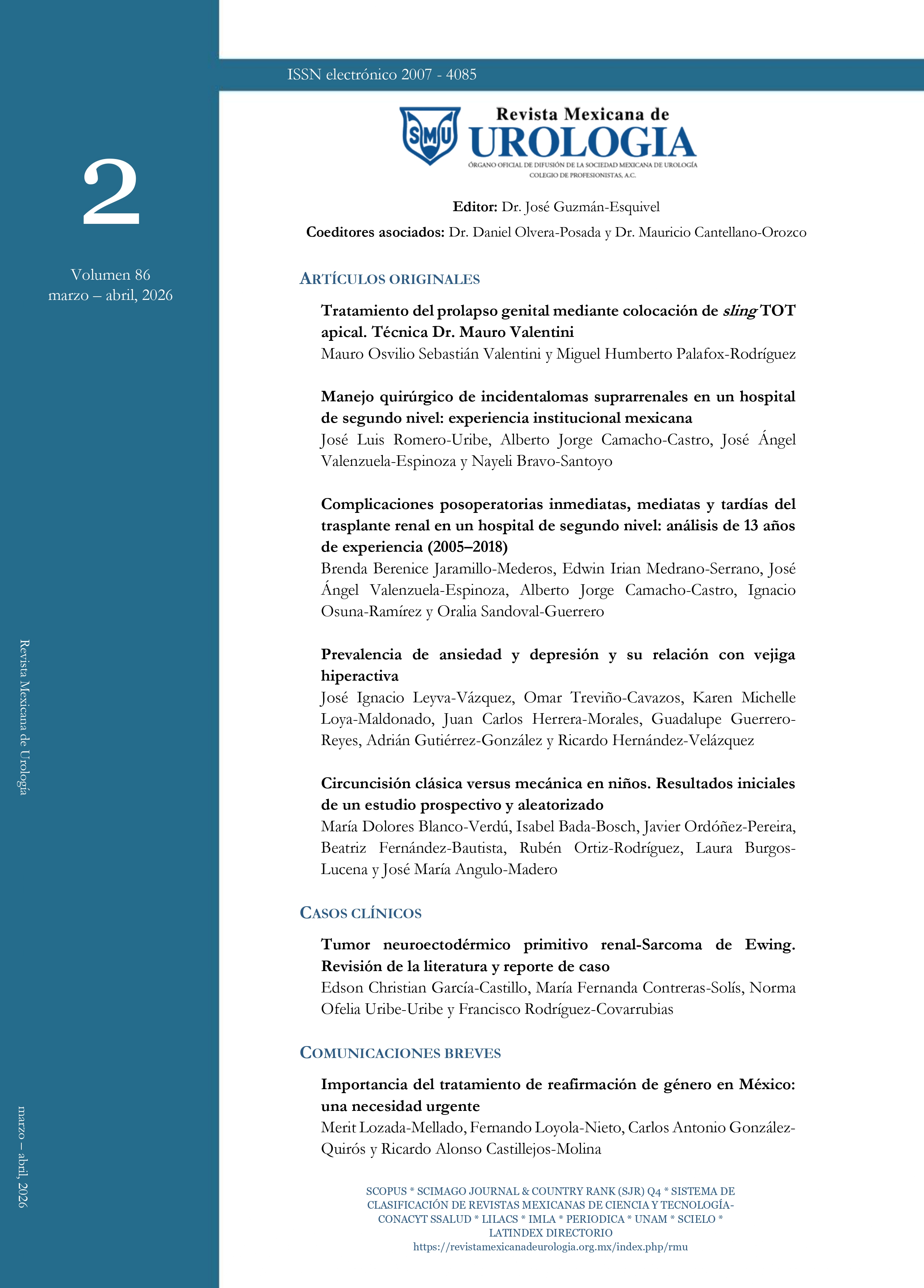
Prevalence of anxiety and depression and their relationship with overactive bladde
DOI:
https://doi.org/10.48193/97gggb27Keywords:
Depression, Anxiety, Overactive Bladder, Urinary UrgencyAbstract
Background: overactive Bladder Syndrome (OAB) is defined by the International Continence Society as urgency, frequency, and nocturia, with or without urge urinary incontinence (UUI), in the absence of urinary tract infection. In Mexico, a prevalence of OAB has been reported at 19 %. These urinary symptoms can lead to affective disorders; in the United States, the prevalence of anxiety and depression in patients with OAB is 16.9 %.
Objective: to determine the prevalence of anxiety and depression and their relationship with overactive bladder.
Material and methods: prolective, cross-sectional, analytical study in a tertiary care center. From August 1 to September 30, 2024. Consecutive sampling. 95 adult female patients with OAB were included. Validated Spanish questionnaires were used: the International Consultation on Incontinence Questionnaire for Overactive Bladder (ICIQ-OAB) and the Depression, Anxiety, and Stress Scale-21 (DASS-21). The Excel 2016 database. Association with Fischer´s exact, and SPSS v25® were used.
Results: the 70-79 age group presented symptoms in 31.6 %. The most common OAB symptoms were urgency and UUI, with 50.5 % and 47.4 % reporting “sometimes.” Of the total patients, 10.5 % presented depression and 17.9 % anxiety. No significant association was found between OAB symptoms and affective disorders.
Conclusions: depression and anxiety are prevalent in women with OAB. Studies with larger samples and control groups are needed to corroborate the associations between OAB symptoms and affective disorders.
References
Bradley CS, Nygaard IE, Hillis SL, Torner JC, Sadler AG. Longitudinal associations between mental health conditions and overactive bladder in women veterans. American Journal of Obstetrics and Gynecology. 2017;217(4): 430.e1-430.e8. https://doi.org/10.1016/j.ajog.2017.06.016.
Coker AO, Coker OO, Sanni D. Psychometric properties of the 21-item Depression Anxiety Stress Scale (DASS-21). African Research Review. 2018;12(2): 135. https://doi.org/10.4314/afrrev.v12i2.13.
Cruz-Ruíz J, Farrera-González V, Ransom-Rodríguez A, Avalos-Jiménez J C, Landa-Soler M, González-Serrano A, et al. Prevalencia de vejiga hiperactiva en la Ciudad de México. Resultados de un análisis preliminar. Revista Mexicana de Urología. 2018;78(3). https://doi.org/10.48193/revistamexicanadeurologa.v78i3.77.
D’Ancona C, Haylen B, Oelke M, Abranches-Monteiro L, Arnold E, Goldman H, et al. The International Continence Society (ICS) report on the terminology for adult male lower urinary tract and pelvic floor symptoms and dysfunction. Neurourology and Urodynamics. 2019;38(2): 433–477. https://doi.org/10.1002/nau.23897.
Golabek T, Skalski M, Przydacz M, Świerkosz A, Siwek M, Golabek K, et al. Lower urinary tract symptoms, nocturia and overactive bladder in patients with depression and anxiety. Psychiatria Polska. 2016;50(2): 417–430. https://doi.org/10.12740/PP/OnlineFirst/59162.
Kawahara T, Ninomiya S, Tsutsumi S, Ito H, Yao M, Uemura H. Impact of depression on overactive bladder. International Journal of Urology: Official Journal of the Japanese Urological Association. 2021;28(2): 245–246. https://doi.org/10.1111/iju.14434.
Kinsey D, Pretorius S, Glover L, Alexander T. The psychological impact of overactive bladder: A systematic review. Journal of Health Psychology. 2016;21(1): 69–81. https://doi.org/10.1177/1359105314522084.
Lai HH, Shen B, Rawal A, Vetter J. The relationship between depression and overactive bladder/urinary incontinence symptoms in the clinical OAB population. BMC urology. 2016;16(1): 60. https://doi.org/10.1186/s12894-016-0179-x.
Melotti IGR, Juliato CRT, Coelho SC de A, Lima M, Riccetto CLZ. Is There Any Difference Between Depression and Anxiety in Overactive Bladder According to Sex? A Systematic Review and Meta-Analysis. International Neurourology Journal. 2017;21(3): 204–211. https://doi.org/10.5213/inj.1734890.445.
Melotti IGR, Juliato CRT, Tanaka M, Riccetto CLZ. Severe depression and anxiety in women with overactive bladder. Neurourology and Urodynamics. 2018;37(1): 223–228. https://doi.org/10.1002/nau.23277.
Palma T, Raimondi M, Souto S, Fozzatti C, Palma P, Riccetto C. [Correlation between age and overactive bladder symptoms in young women in Brazil]. Actas Urologicas Espanolas. 2013;37(3): 156–161. https://doi.org/10.1016/j.acuro.2012.07.009.
Gurrola Peña G M, Balcazár Nava P, Bonilla Muños M P, Virseda Heras J A. Estructura factorial y consistencia interna de la escala de Depresión Ansiedad y Estrés (DASS-21) en una muestra no clínica. Psicología y Ciencia Social/Psychology and Social Science. 2013;8(2). https://www.redalyc.org/pdf/314/31480201.pdf
Pethiyagoda Aub, Pethiyagoda K, Ariyasinghe Di, Wijesinghe S, Dimiyawa Km, Wijethunga Tm. Relationship between Lower Urinary Tract Symptoms and Emotional State among a Sample of Clinic Attendees of a Tertiary Care Center in Central Sri Lanka. Archives of Nephrology and Urology. 2022;04(04). https://doi.org/10.26502/anu.2644-2833046.
Reis AM, Brito LGO, Lunardi ALB, Pinto e Silva MP, Juliato CRT. Depression, anxiety, and stress in women with urinary incontinence with or without myofascial dysfunction in the pelvic floor muscles: A cross-sectional study. Neurourology and Urodynamics. 2021;40(1): 334–339. https://doi.org/10.1002/nau.24563.
Ruiz F, García Martín MB, Suárez Falcón JC, Odriozola González P. The hierarchical factor structure of the Spanish version of Depression Anxiety and Stress Scale-21. 2017; https://repositorio.unican.es/xmlui/handle/10902/38496
Downloads
Published
Issue
Section
License
Copyright (c) 2026 Revista Mexicana de Urología

This work is licensed under a Creative Commons Attribution-NonCommercial-NoDerivatives 4.0 International License.


